

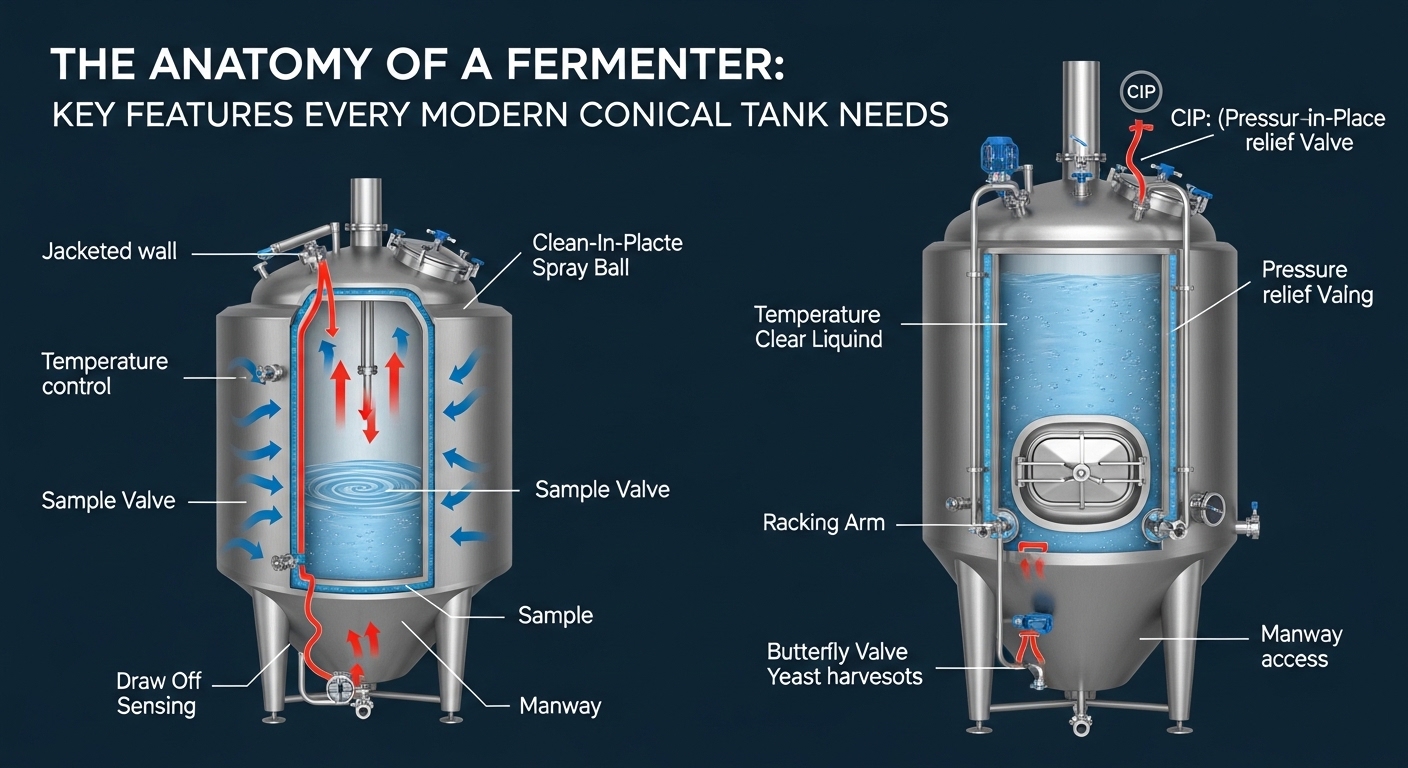
In the world of professional brewing, the brewhouse is often where the “magic” starts, but the fermenter is where the beer is actually made. In 2026, as craft beer consumers demand extreme consistency, shelf stability, and complex flavor profiles—from hazy IPAs to crisp Italian Pilsners—the technical requirements for fermentation vessels have reached an all-time high.
The modern Unitank (a conical fermenter capable of both primary fermentation and carbonation) is a marvel of sanitary engineering. Understanding the “anatomy” of these vessels is crucial for any brewer looking to produce world-class beverages. Here is an in-depth breakdown of the essential features every modern conical tank needs to compete in today’s market.
1. The Geometry: Why the 60° Cone is Standard
The defining feature of a modern fermenter is its conical bottom. While older breweries once used open-top flat-bottomed fermenters, the industry has standardized on the 60-degree cone.
Yeast Management and Collection
The 60-degree angle is the “sweet spot” of physics for brewing. It is steep enough to allow dormant yeast and trub (hop particulate and proteins) to settle into the very bottom of the cone without “bridging” or getting stuck on the sides. This allows the brewer to “dump” the trub early in the process and harvest healthy yeast for the next batch, ensuring a clean fermentation environment.
During active fermentation, the yeast produces heat and CO2. In a conical tank, this creates natural convection currents. The liquid rises in the center and falls along the cooled jacketed walls. This movement keeps the yeast in suspension longer, leading to more efficient attenuation and a more consistent flavor profile across the entire batch.
2. Material Science: 304 vs. 316L Stainless Steel
Not all stainless steel is created equal. In 2026, the industry standard for the interior “wetted” surface of a fermenter is 304 stainless steel, but there is an increasing move toward 316L for specialized applications.
304 stainless steel offers excellent resistance to the organic acids found in beer. However, for breweries producing high-acidity products like sour ales, kombucha, or hard seltzers, 316L (which contains molybdenum) provides superior protection against pitting and chloride corrosion.
Surface Finish (The Ra Factor)
The most critical “invisible” feature of a fermenter is its Roughness Average (Ra). A modern tank must have an internal finish of Ra ≤ 0.4µm.
Why it matters: At a microscopic level, unpolished steel looks like a mountain range. Bacteria and wild yeast can hide in the “valleys” where chemicals cannot reach. A mirror-polish finish ensures that the CIP (Clean-In-Place) process is 100% effective.
3. The Cooling Jacket: Precision Temperature Control
In 2026, temperature control is the difference between a gold-medal lager and a batch destined for the drain. Modern fermenters utilize dimple jackets for glycol cooling.
A professional tank should have at least two cooling zones: one on the cone and one on the side-wall (cylinder).
The Cone Jacket: Essential for crashing the yeast and keeping it cool once it has settled, preventing autolysis (yeast death), which can cause rubbery off-flavors.
The Cylinder Jacket: Manages the heat of the active fermentation.
By having independent control over these zones, brewers can manage the “thermal mass” of the beer more precisely, preventing temperature spikes that lead to unwanted esters or fusel alcohols.
4. Insulation and the Outer Shell
Efficiency is a major driver of brewery profitability in 2026. A modern fermenter must be fully insulated and “cladded.”
High-quality tanks use pressure-injected polyurethane foam (usually 80mm to 100mm thick) between the inner tank and the outer shell. Unlike fiberglass batting used in the past, injected foam fills every void, eliminating “cold spots” where condensation can form.
The outer cladding should be fully TIG-welded. Cheap tanks often use “pop-riveted” or “wrapped” outer shells. A fully welded exterior prevents moisture from seeping into the insulation, which can lead to mold growth and “insulation rot” over time.
5. The Manway: Ergonomics and Sanitation
The manway is the primary entry point for dry-hopping and manual inspection. In 2026, the Side-Shadowless Manway has become the preferred choice over top-mounted manways.
Shadowless Design: This means the internal flange of the manway is flush with the tank wall. In older designs, the manway created a “lip” where the CIP spray ball couldn’t reach, creating a “shadow” that required manual scrubbing.
Pressure Rating: Modern manways must be rated for at least 2 bar (30 psi) to allow for safe carbonation and pressurized transfers.
6. Ports, Valves, and Fittings: The “Business End”
The functionality of a fermenter is determined by its peripheral hardware. Every modern tank needs a specific set of high-quality fittings:
Located on the cone, the racking arm allows the brewer to rotate a pick-up tube inside the tank. This enables you to draw clear beer from above the yeast bed. As the beer clears, you can rotate the arm lower to maximize your yield.
The Carbonation Stone (Carb Stone)
A 10-inch or 12-inch porous stainless steel stone allows for the injection of fine CO2 bubbles directly into the beer. This turns a fermenter into a Unitank, allowing you to carbonate the beer in the same vessel it fermented in, reducing the risk of oxidation during transfer.
A sanitary sample valve is essential for daily gravity and pH checks. Modern versions are designed to be easily “flamed” or sanitized with alcohol to prevent contaminating the tank during sampling.
7. Safety and Pressure Management
Fermenters are pressure vessels. In 2026, safety features are non-negotiable for both staff protection and beer quality.
PVRV (Pressure/Vacuum Relief Valve)
This dual-action valve protects the tank from two directions:
Over-pressure: If a fermentation is too vigorous or a CO2 regulator fails, the valve vents gas to prevent a tank explosion.
Vacuum: During a cold crash or a CIP cycle with cold water, the gas inside the tank can contract rapidly. Without a vacuum relief valve, the atmospheric pressure outside would implode the stainless steel tank like a soda can.
8. CIP (Clean-In-Place) Technology
Labor is the highest cost for most breweries. A modern fermenter is designed to clean itself via a CIP arm.
Spray Ball: A 360-degree rotating or fixed spray ball ensures every square inch of the interior is hit with caustic or sanitizer.
Dedicated CIP Pipe: The CIP arm should be separate from the blow-off arm to prevent “clogging” during high-krausen fermentations.
9. Dry-Hopping Ports and Automation
With the continued dominance of New England IPAs, modern fermenters often include a 4-inch or 6-inch dry-hop port at the top. 2026 models often feature “hop dosers” or “hop cannons” that allow for hop additions under pressure, preventing oxygen ingress—the number one enemy of hop aroma.
Recommendation: Micet Brewing Equipment
When it comes to sourcing a vessel that hits every one of these modern requirements, Micet Group is the industry benchmark. Micet fermenters are engineered for the rigorous demands of 2026 brewing standards.
Why Micet?
Precision Polishing: Every Micet tank comes with a guaranteed Ra ≤ 0.4µm interior finish and automatic circumferential welding for a seamless, bacteria-free surface.
Certified Safety: Their vessels are built to international pressure standards (PED, ASME, CE), ensuring your team is safe and your investment is protected.
High-Performance Insulation: Micet uses high-density polyurethane injection, ensuring that your glycol chiller runs efficiently even in the hottest summer months.
Customization: Whether you need a low-profile tank for a basement brewery or a 100BBL production vessel, Micet’s engineering team provides the CAD support to ensure your tank “anatomy” fits your space perfectly.
By choosing Micet, you aren’t just buying a tank; you are investing in a piece of high-precision laboratory equipment designed to make the best beer possible.
Frequently Asked Questions (FAQ)
1. What is the difference between a Fermenter and a Unitank?
A traditional fermenter is designed only for fermentation and is typically rated for lower pressures. A Unitank is a “universal” tank rated for higher pressures (up to 30 psi), allowing you to ferment, carbonate, and serve or package beer from the same vessel. Most modern conical tanks sold by Micet are Unitanks.
2. Why is the 60° cone angle so important?
If the angle is too shallow (e.g., 45°), yeast and trub will stick to the walls, making it difficult to harvest yeast or get clear beer. If it’s too steep (e.g., 75°), the tank becomes unnecessarily tall and difficult to fit in standard buildings. 60° is the “Goldilocks” angle for optimal sediment management and convection.
3. How do I prevent my tank from imploding during cleaning?
Always ensure your PVRV (Pressure/Vacuum Relief Valve) is clean and functioning. The most common cause of tank implosion is “thermal shock”—rinsing a hot tank (after a caustic wash) with cold water. This causes the internal air to shrink instantly. A functional vacuum relief valve will open and let air in to equalize the pressure, saving your tank.
 vool Admin